
How to Search Davidson County Traffic Court Records
Traffic records live with the courts that handle them. The Criminal Court Clerk public search at sci.ccc.nashville.gov accepts a case number, and its validation references a warrant or ticket number. The Traffic Violation Bureau, part of the Circuit Court Clerk, handles payment and related functions. Start by identifying whether your ticket is Metro traffic, state traffic, or a criminal charge.
A ticket or citation number gives the most precise result. Without one, a name search in the relevant court system can locate the case. For payment, use only the official clerk payment links.
Which Courts Handle Traffic Cases in Davidson County
Traffic is split between two dockets. State Traffic runs on Wednesdays at 8:30 a.m. in Courtroom 5D. Metro Traffic runs Monday through Thursday at 8:30 a.m. in Courtroom 1B. The General Sessions Court has jurisdiction over Metro ordinance violations, including traffic and codes cases, a power it gained through the 1971 Metro Charter consolidation. The Traffic Violation Bureau handles payment and clerk functions from the Birch Building.
The General Sessions maps and directions page shows the Birch Building location for traffic matters.
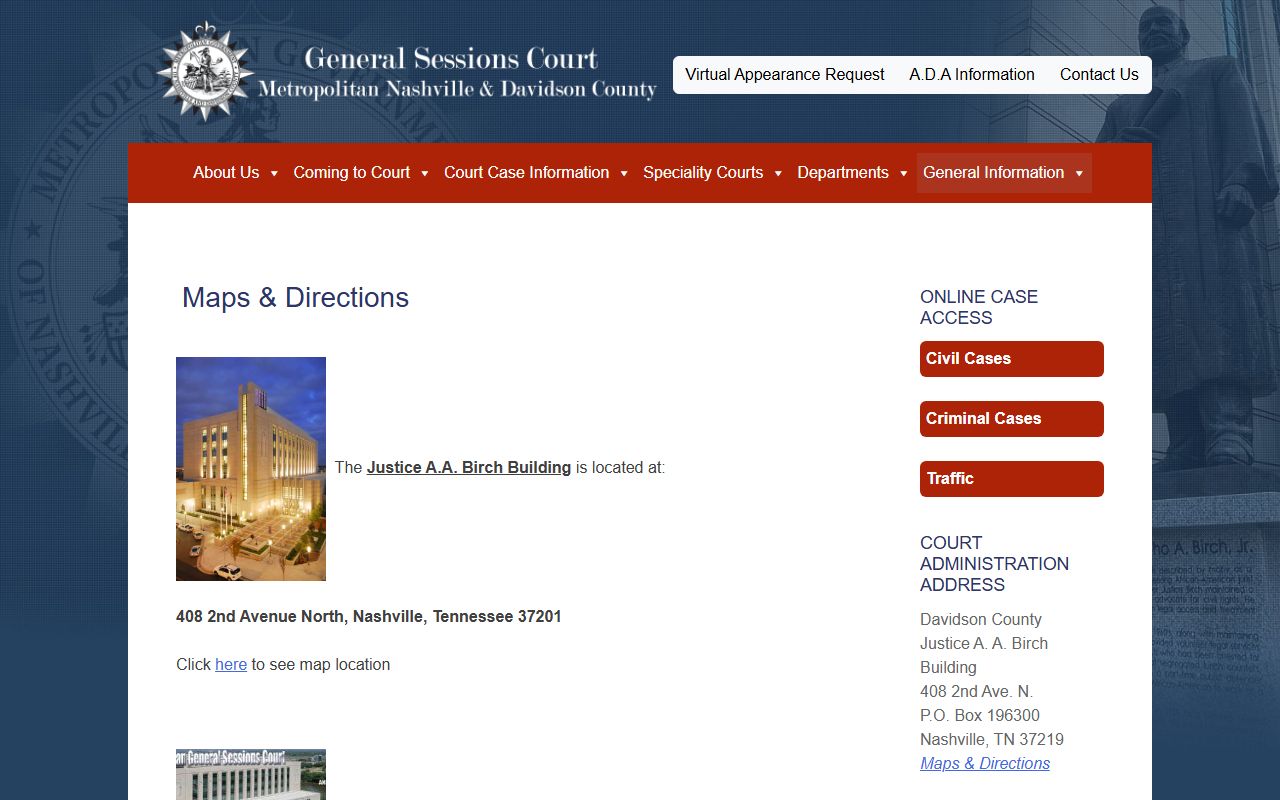
The Traffic Violation Bureau sits in the Birch Building, Suite 1160, with hours that close a few minutes earlier than most clerk offices. Because the state and Metro dockets meet on different days, confirm your docket type before you plan a trip downtown.
Types of Traffic Cases on Record
Not every traffic case is the same. A parking or minor moving violation is handled very differently from a DUI. The court record reflects that range. The list below covers the common categories that show up in Davidson County traffic records.
- Metro ordinance traffic and codes violations.
- State traffic charges heard on the state traffic docket.
- Failure-to-appear and unresolved citation matters.
- Serious criminal traffic offenses such as DUI.
- Commercial driver and CDL-related citations.
What Davidson County Traffic Court Records Show
A traffic court record is tied to a citation and a court date. It tracks the charge, the outcome, and any money owed. The fields below show what a Davidson County traffic court record usually carries.
| Field | What It Shows |
|---|---|
| Citation / Case Number | The ticket or case identifier. |
| Charge or Offense | The traffic or ordinance violation cited. |
| Court Date and Courtroom | When and where the case is set. |
| Disposition | The outcome of the charge, if concluded. |
| Fine and Costs | Any fine and court costs owed. |
| Warrant / FTA Status | Whether a failure to appear or warrant is noted. |
Searching by Citation Number vs by Name
You can search two ways. A citation or ticket number is the most exact. A name search works when you do not have the number. The Criminal Court Clerk search uses a Case Number mode whose validation references a valid warrant or ticket number, with a minimum of three characters. The fields below show that search.
| Field Label | Type | Required | Notes |
|---|---|---|---|
| Select Search Type | Dropdown | Yes | Choose Case Number for a ticket search. |
| Case Number | Text | Yes | Valid warrant or ticket number; minimum three characters. |
| First and Last Name | Text | For person search | Used when no ticket number is known. |
Paying or Contesting a Davidson County Traffic Ticket
How you handle a ticket depends on the type. A simple Metro citation can often be paid, while a serious charge needs a court appearance. The steps below follow the process the research supports.
- Identify whether the ticket is Metro, state traffic, or criminal.
- Search by case or ticket number in the right court system.
- To pay, use only official Criminal Court Clerk or Circuit Clerk payment links.
- To contest, appear on the docket date or follow clerk instructions.
- If you missed court, check for a warrant and call the clerk first.
Do not assume paying online clears a missed court date; a failure to appear may have already triggered a warrant.
Public Access Laws for Traffic Court Records
Traffic court records are court records, so the same access rules apply. The Tennessee Public Records Act presumes open access, and Tennessee Supreme Court Rule 34 governs court records unless a record is sealed or excepted. For an ordinary traffic case, the clerk and a citation number are the fastest path. Expunged traffic-related charges are removed from public display like other expunged records.
For the broader access framework, see the public records page.
Court Traffic Records vs State Driver Records
This is the distinction that trips up the most people. The court traffic record is the case file: charge, court date, disposition, and fine. The state driver record is a separate file kept by the Tennessee driver services system, showing license status, points, and suspensions. The court can show the outcome of a charge. Only the state record shows points and license consequences.
| Point | Court Traffic Record | State Driver Record |
|---|---|---|
| Record source | General Sessions / clerk | State driver services |
| What is in it | Charge, court date, disposition, fine | License status, points, suspensions |
| Where to access | Court clerk systems | State driver services |
| How to correct an error | Through the court clerk | Through driver services |
CDL and Commercial Driver Records
Commercial drivers face stricter rules. A citation that is minor for a regular license can carry serious consequences for a commercial driver license. Court dispositions on a traffic case can flow into the state driver record and affect a CDL. Because the court record and the driver record are separate, a CDL holder should track both after a ticket.
For how a disposition reaches the driver record, the state driver services system is the authority, not the county court.
DUI and DWI Cases
A DUI is not a simple traffic ticket. Serious impaired-driving charges route through the criminal side, not a quick payment window. They carry court appearances, possible jail consequences, and a separate impact on the driver record. The Criminal Court Clerk and the criminal docket handle these matters.
A DUI also affects the court record and the driver record in different ways, and the two consequences are separate. For the criminal process and expungement guidance, see the arrest records page. Because the stakes are high, counsel is worth considering before any court date.
Deferred Adjudication and Defensive Driving
Some traffic cases can be resolved without a conviction on the record. Options like a driving course or a deferred resolution may be available for eligible citations, depending on the charge and the court. These paths can keep points off a driver record or reduce the impact of a charge. Eligibility is set by the court, not by the driver.
Ask the clerk or the court whether a course or deferred option applies to your specific citation before the court date.
Sealing or Expunging Traffic Records
Eligible traffic-related charges can sometimes be expunged, like other criminal records in Tennessee. Expunction is usually not automatic and requires a petition to the court that handled the case. Once expunged, a charge is removed from the public search, and republishing it can be a criminal offense. Many serious offenses do not qualify.
The Criminal Court Clerk and the District Attorney both publish expungement guidance for Davidson County cases.
Fees for Traffic Record Copies
Copy fees for traffic records follow the clerk's standard schedule. Plain copies are charged per page, and a certified copy adds a flat certification fee. The amounts below were listed on the official pages at research time. A certified copy is the version accepted for official use.
| Item | Amount |
|---|---|
| Plain copy per page | $0.50 |
| Certified copy | $5 certification + $0.50/page |
| Congressional certification | $10 certification + $0.50/page |
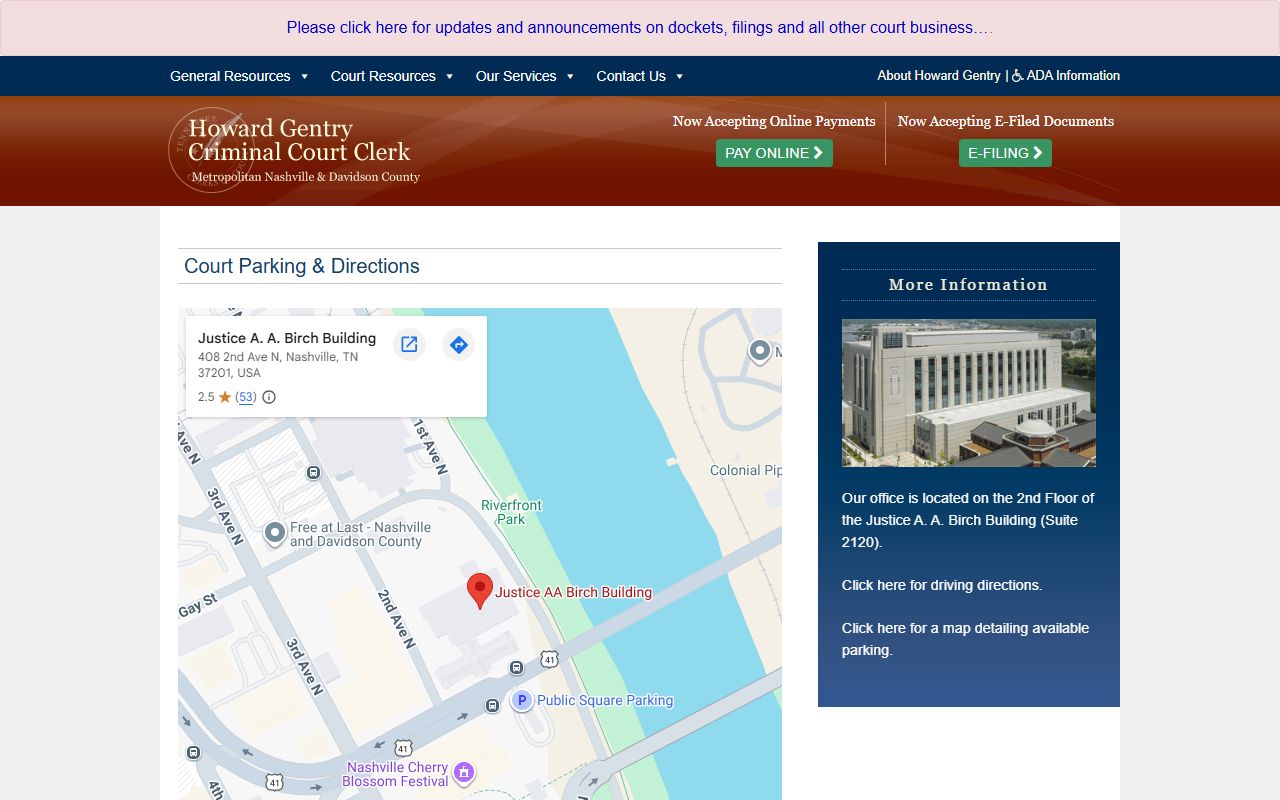
The Criminal Court Clerk parking and directions page helps if you need to visit in person.
Note: Confirm current fees and accepted payment with the clerk before you mail or bring payment.