
Tennessee Uses Circuit Courts, Not District Courts
People often search for a "district court" in Tennessee, but the state does not use one at the trial level. The general civil trial court is the Circuit Court. In Davidson County, eight Circuit Court divisions hear contracts, torts, condemnations, workers' compensation, domestic relations, and estate administration. Alongside Circuit sit Chancery, Criminal, and Probate, with General Sessions and Juvenile as the limited-jurisdiction courts below them.
So a Davidson County trial court search starts by matching the case type to the right court, then the right clerk.
The Twentieth Judicial District
Davidson County makes up Tennessee's Twentieth Judicial District. The district holds the trial courts of general jurisdiction, which are Circuit, Chancery, Criminal, and Probate. Below them are the courts of limited jurisdiction, mainly General Sessions, Juvenile, and Municipal. The Tennessee Courts site describes this trial court structure statewide.
Because Nashville is the state capital and a large urban county, the district carries heavy civil and criminal caseloads through these courts.
Davidson County Trial Courts
Each trial court has its own jurisdiction and its own location. The table below lists the Davidson County courts with the addresses and clerk phone numbers found in the research. The Circuit, Probate, and Chancery courts sit at the Historic Metropolitan Courthouse, while criminal and General Sessions work happens at the Birch Building.
| Court | Jurisdiction | Address | Phone |
|---|---|---|---|
| Circuit Court (8 divisions) | Civil trial court | 1 Public Square, Suite 302 | 615-862-5181 |
| Chancery Court | Equity | 1 Public Square, Suite 308 | 615-862-5710 |
| Criminal Court | State criminal | 408 2nd Ave N, Suite 2120 | 615-862-5601 |
| Probate / Seventh Circuit | Estates | 1 Public Square, Suite 302 | 615-862-5980 |
| General Sessions | Limited | 408 2nd Ave N | 615-862-5195 |
Circuit Court Divisions
The Circuit Court is the workhorse for civil matters. Its eight divisions hear a broad mix of cases, from contract disputes and personal injury torts to workers' compensation and domestic relations. Divorce and family cases are handled here, which is why divorce records route through the Circuit Court Clerk. Estate administration also touches the Circuit Court through its Probate function.
The Circuit Court Clerk keeps the records for all eight divisions, plus the civil records of the General Sessions courts. Each division operates as its own court, so a case is assigned to a specific division and that is where its hearings and filings are handled.
Chancery, Criminal, and Probate Courts
Three more general-jurisdiction courts round out the trial level. Chancery Court handles equity, injunctions, tax, property, and business disputes, with records going back to May 1846. The Criminal Court hears indicted felony and serious criminal cases. The Probate Division, part of the Seventh Circuit Court, handles wills, estates, conservatorships, and guardianships. Each keeps its records with a different clerk, which is the heart of the county's split clerk structure.
For probate detail, see probate records. For the clerk structure, see the Circuit Court Clerk page.
General Sessions Court
General Sessions is the limited-jurisdiction court most people meet first. It has eleven elected judges and fifteen law-trained magistrates. Its civil side handles claims up to $25,000, plus landlord-tenant cases with original and unlimited jurisdiction. Its criminal side handles misdemeanor trials and preliminary hearings for felonies, along with Metro traffic and ordinance matters.
The General Sessions jurisdiction page lays out these limits and the court's history.
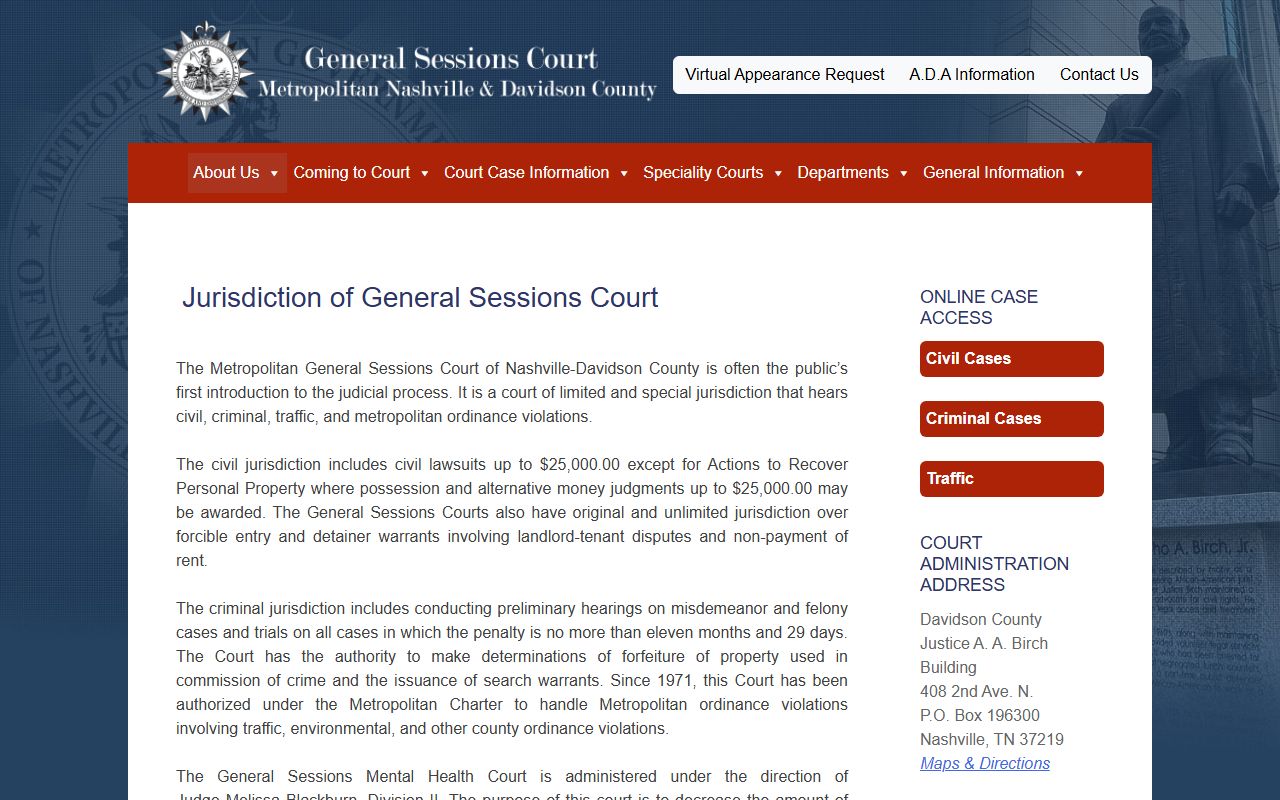
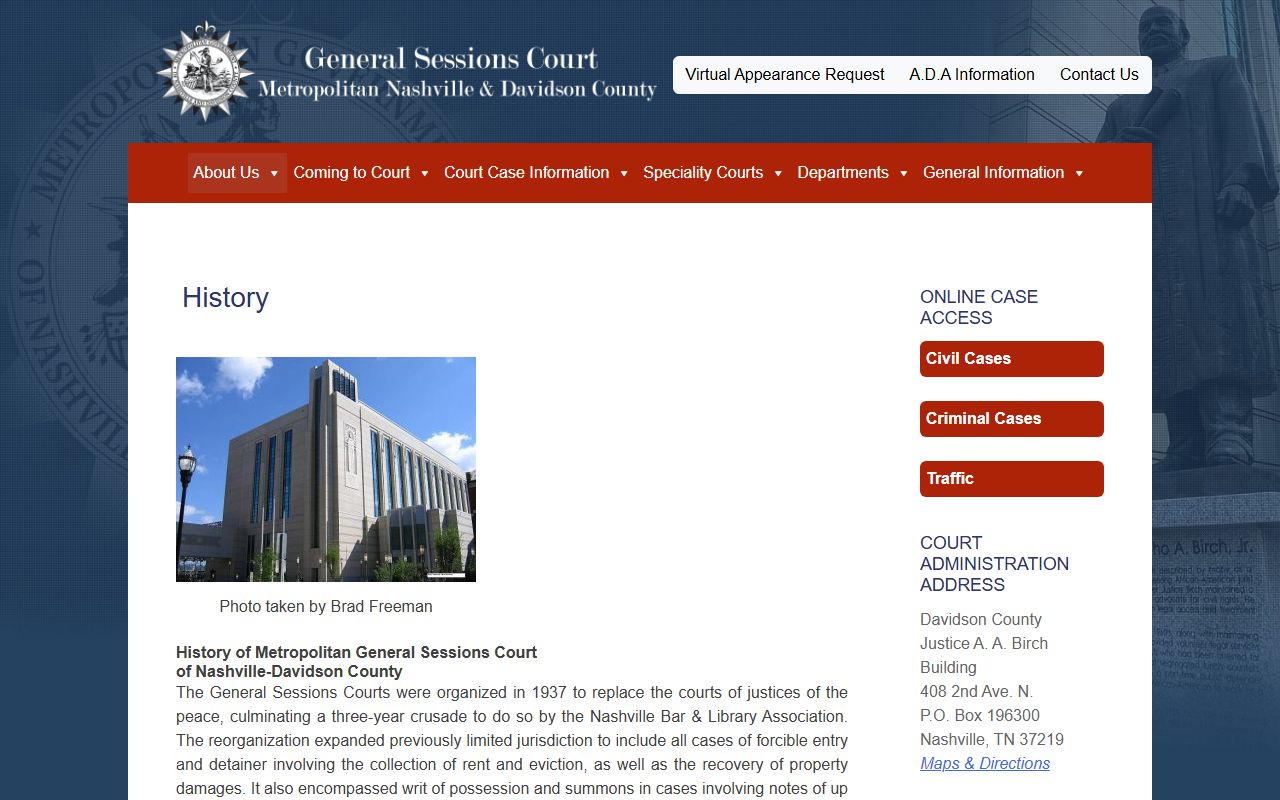
General Sessions was organized in 1937 to replace the old justice of the peace courts, and it grew to eleven judges by 1998. It is a limited-jurisdiction court, but it is often the public's first contact with the court system.
Circuit Court vs General Sessions vs Criminal Court
These three courts handle very different work, and people mix them up. Circuit is the civil trial court. General Sessions is the limited court for smaller civil claims and lower-level criminal matters. The Criminal Court handles serious, indicted criminal cases. The comparison below shows how they differ.
| Point | Circuit Court | General Sessions | Criminal Court |
|---|---|---|---|
| Case type | Civil and family | Limited civil and lower criminal | Serious criminal |
| Civil limit | No fixed cap | Up to $25,000 | Not civil |
| Records clerk | Circuit Court Clerk | Split by civil or criminal | Criminal Court Clerk |
How a Case Moves Through the System
Cases follow a path through the courts. A lower-court matter can begin in General Sessions, then move up if it is bound over or appealed. Civil and criminal cases each have their own route to the appellate courts. The flow below shows the typical path for a Davidson County case.
Case flow: General Sessions › Circuit or Criminal Court › Court of Appeals or Court of Criminal Appeals › Tennessee Supreme Court
Not every case touches every level. Many resolve at the trial court without an appeal.
Appeals Path
The appeals route depends on the case type. Civil appeals from the trial courts go to the Tennessee Court of Appeals. Criminal appeals go to the Tennessee Court of Criminal Appeals. The Tennessee Supreme Court is the court of last resort and takes cases on discretionary review. Federal claims, federal crimes, and bankruptcy are filed in the federal courts, not the county courts.
The General Sessions Court history page traces how the lower court reached its current form.
So a civil and a criminal case from the same county can end up in two different appellate courts.
Federal Courts Serving Davidson County
Some cases never touch the county courts at all. Federal crimes, constitutional claims, and federal civil cases are filed in the U.S. District Court for the Middle District of Tennessee, whose Nashville courthouse is at 719 Church Street. Bankruptcy is handled by the U.S. Bankruptcy Court for the Middle District of Tennessee at 701 Broadway. Federal case access runs through PACER, not the county clerk systems.
If a matter is federal, the county Circuit Court and its clerk are not the place to file or search. The federal courts keep their own dockets and records.
Specialty Courts
The trial court system also runs problem-solving courts. The General Sessions Recovery Court works with substance use cases. The Mental Health Court and the Veterans Treatment Court coordinate treatment for qualifying defendants. The Sheriff's Behavioral Care Center provides a treatment-based alternative to jail. These programs sit alongside the regular dockets and carry their own intake and schedules. They aim to address the cause of repeat offenses rather than simply move a case through the system.